
Episode 4: The day Minecraft taught you to draw a sphere that wasn’t one
Minecraft, discretization, and the eternal problem of the continuum.
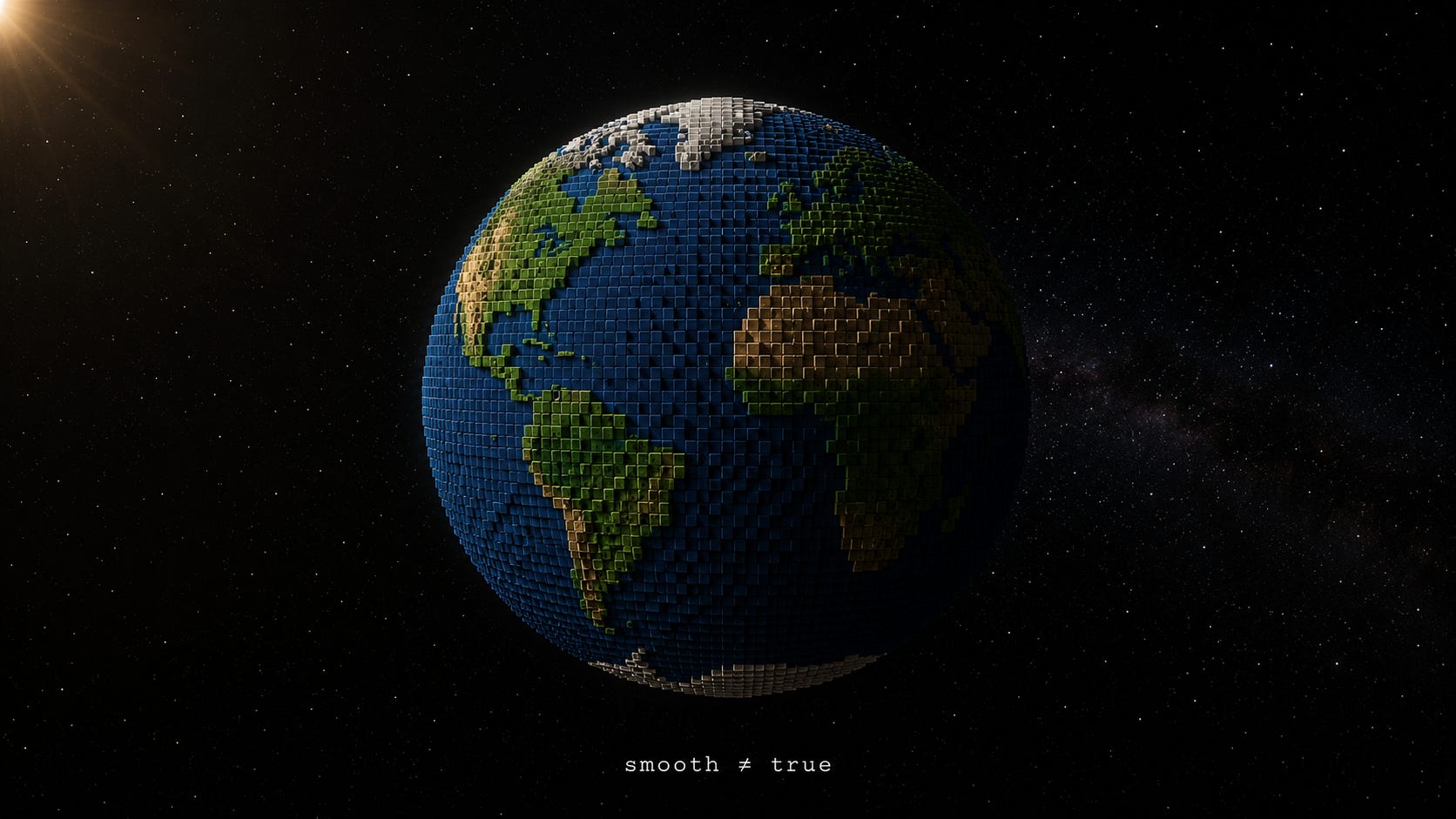
You want to build a sphere.
You know roughly what it should look like: a round object, no angles, no edges, smooth everywhere. You’ve seen a thousand spheres: an orange, a marble, the Earth from space. It’s one of the simplest shapes geometry knows.
You start with a four-block radius. The result looks like a cubic potato. You laugh, tear it down, try again with radius eight. Better, but still very angular: you see stair-steps on every “side,” flat plateaus that have nothing spherical about them. You push to sixteen. Now it starts to suggest a sphere, seen from a distance, if you squint a little. At thirty-two, you almost believe it. At sixty-four, from far enough away, it really is a sphere.
But come closer. Put your avatar one block from the surface. Look. You see steps. You see corners. You see the grid. The closer you zoom, the more the sphere reverts to a stack of cubes. No amount of refinement makes that cubic nature disappear: it just makes it smaller.
You can push to one hundred twenty-eight blocks, to one thousand and twenty-four, to a million. The sphere will become more and more convincing from a distance, but it will never be a true sphere. A true sphere has no smallest element. A Minecraft sphere does.
That frustration you felt building your first big ball is exactly the central problem of all modern numerical physics. And it’s also, perhaps, the central problem of the real universe itself.
The smooth world versus the blocky world
In mathematics, ever since Euclid, we’ve had a very clear intuition about the difference between two kinds of objects.
There are discrete objects: a bag of marbles, a chessboard, a list of whole numbers. You can count them. Between two neighbors, there’s nothing. You jump from one to the next. No half-marble, no square between squares.
And there are continuous objects: a straight line, a sphere, the water in a glass. Between two points, there’s always a third point. You can zoom forever and you’ll always find something between. No smallest segment, no smallest volume.
For a long time, physicists assumed nature was fundamentally continuous. Space, time, fields, everything could be zoomed indefinitely, and you’d always find smoothness, always fluidity, never the slightest grain. That’s the picture that dominates Newton, Maxwell, Einstein. The world is a continuous expanse in which things move continuously.
Then came computers.
The drama of simulation
A computer can’t do continuous. A computer only knows numbers, and it has a finite number of them. Its memory is made of bits, which are 0 or 1, with no half-bit possible. A number in a computer always has a limited number of digits after the decimal point. You can have many of them, but never an infinity.
So the moment we tried to simulate physics in a computer, we hit this wall. How do you represent a smooth wave with a finite number of points? How do you represent continuous space with a grid? How do you represent a particle that can be anywhere with a system that only knows a finite number of possible positions?
The answer we’ve been using for fifty years: we discretize. We cut space into small cells, time into small intervals, values into small steps. We do Minecraft, basically. And we hope that if we cut finely enough, the result will resemble closely what a continuous calculation would have given.
When a physicist simulates Earth’s atmosphere to forecast the weather, they cut the planet into cubes a few kilometers across. When we simulate climate, we go up to tens of kilometers. When we simulate a collapsing star, we cut with meshes adapted to the local density. When we calculate the mass of the proton from the quarks that compose it, we cut spacetime itself into a grid a few fermis across: this is lattice QCD, and it’s our best proof that discretization, done rigorously, gives predictions that match experimental measurements to ten decimal places. When we simulate the geometric structure of an abstract seven-dimensional manifold (I’ll come back to that), we cut with neural networks that learn to interpolate between mesh points.
Every time, the same problem: discretization is a betrayal of the continuous. We do our best. We refine. We check that results converge as we refine further. But we know, intimately, that we’re building a Minecraft sphere. The true sphere, we don’t touch. We approximate it.
Why Minecraft gives you exactly the right intuition
When you build your big Minecraft sphere, you live exactly what a numerical physicist lives every day, with one difference: you know you’re doing Minecraft, because the blocks are big and you can count them. The physicist does Minecraft at very high resolution, and sometimes forgets they’re doing Minecraft.
Three valuable intuitions come automatically when you play:
The first: the higher the resolution, the more convincing the illusion, but the illusion never becomes the thing. You know, viscerally, that there’s always a scale below which your sphere stops being a sphere and reverts to blocks. That’s exactly what a physicist feels when looking at a very high-resolution simulation: at large scale, it resembles. At small scale, it reverts to a grid.
The second: some properties survive discretization, others become tricky. The radius of your Minecraft sphere is fairly robust, even coarsely. Its volume too, roughly. But its pointwise curvature becomes much more delicate: if you look block by block, you no longer see a smooth curvature varying gently, you see flat faces and edges. You can rig up notions of discrete curvature that give something close at large scale, but the property “smooth at every point” is broken by local discretization. The numerical physicist spends their life knowing which quantities are robust to discretization and which become artifacts.
The third: the grid itself introduces artifacts that don’t exist in the continuum. Your Minecraft sphere has six “preferred” faces (top, bottom, north, south, east, west), because your blocks are aligned on axes. A true sphere has no preferred direction, it’s perfectly symmetric. So your Minecraft sphere has less symmetry than the sphere it’s supposed to represent. The numerical simulator lives with this constantly: the grid breaks symmetries of nature, and you have to know it to avoid confusing a real effect with a grid artifact.
You didn’t learn these three things at school. You learned them by spending three afternoons building a ball to decorate.
Two questions not to confuse
Before going further, we need to separate two things that resemble each other and that the rest of this episode will connect, but that are logically distinct.
The first question is: what do we lose when we simulate the continuous with the discrete? That’s the question of meteorologists, climatologists, numerical physicists, and it’s the one you live in Minecraft. It exists even if nature is, otherwise, perfectly continuous. You can have a strictly smooth universe, and still do calculations in discrete form out of instrumental necessity. It’s a limit of our tools, not a claim about the world.
The second question is: what if nature itself were fundamentally discrete at very small scales? That’s an open question of fundamental physics, with no direct bearing on our computational limits. The universe could be smooth all the way down, and we’d be condemned to simulate it coarsely. Or the universe could be discrete, and our discrete simulations would then, by coincidence, be faithful to its deep nature. The two questions don’t answer each other.
Minecraft, for its part, is unambiguously on the side of the first: it’s an approximation tool, with a fixed grid. And that’s where we need to mark the honest limit of the analogy, just as we did with Tetris.
Where Minecraft stops being the image of physics
Minecraft has a fixed grid. Blocks align on three privileged axes: up-down, north-south, east-west. These directions exist before you put anything into them. If you shift your Minecraft sphere by a few meters, or rotate it by 30 degrees, it ceases to be well-defined on the grid: blocks no longer align, you have to rebuild everything. The grid carries an absolute orientation.
Real discrete physics, as theorists try to construct it, refuses precisely this. A serious theory of discrete spacetime cannot have a preferred orientation, because nature at our scale has none: the laws are the same whether you face north or west, whether you move slowly or quickly. So theorists construct models where there is no background grid. The discrete elements (small volumes, small tetrahedra, small nodes connected in a network) don’t exist in a space, they constitute the space through their mutual relations. No axes laid down before them. No absolute North.
Loop quantum gravity does this with what are called spin networks. Causal dynamical triangulations do this with assemblies of tetrahedra of which only the topology matters. In every case, the keyword is background-independent: independent of any fixed backdrop. The discreteness of Minecraft is itself background-dependent: it lives on a preexisting grid.
That’s a deep difference. Minecraft gives you the intuition that the discrete is possible and that it can produce convincing illusions of continuity at large scale. But it also gives you, for free and a bit misleadingly, a fixed grid that real discrete physics doesn’t have. It’s up to you to keep the fundamental intuition (smoothness might be a macroscopic illusion) without transposing Minecraft’s fixed orientation onto nature.
Keep that in mind for what follows.
What if the universe itself were discrete?
Here’s the question that changes everything, and that’s still open in fundamental physics today.
All twentieth-century physics assumed that space and time were continuous. You can zoom indefinitely into matter (and find particles), but the space in which these particles move is assumed smooth, with no smallest element.
This assumption causes problems when you try to combine quantum mechanics with Einstein’s general relativity. When you try, at very small scales, to calculate what happens when gravity becomes quantum, you hit infinities that can’t be managed. The theory breaks. And many physicists since the 1960s have wondered whether this might be the sign that the background assumption (continuous space) is wrong.
The scale where this should happen is called the Planck length, and it’s roughly 1.6 × 10⁻³⁵ meters. To give an idea: if you took an atom and grew it to the size of the observable universe, the Planck length would still be smaller than a grain of sand at that scale. It’s ridiculously tiny. We don’t know how to measure it directly today, and it seems absurdly out of experimental reach. But it is, supposedly, the scale at which space itself might cease to be smooth.
And here, the Minecraft intuition becomes useful provided we correct it: you’ve already seen its limit above. No fixed grid in fundamental physics, no preferred axes. But the fundamental intuition is right: at very small scales, smoothness might disappear in favor of a combinatorics of small elements, and the continuous fabric we perceive at our scale might be only their collective averaged effect, the way your sphere looks round from afar and reveals its blocks up close.
If that’s true, the relation flips completely. It’s no longer you, in Minecraft, trying to make a true sphere with imperfect blocks. It’s the whole universe that’s made of small discrete elements, and you, human sphere, who are the macroscopic illusion of an assembly at very small scale. You, your coffee cup, the Moon, everything. Illusions of smoothness so well refined that they fool every measurement we know how to make.
No one yet knows if that’s the case. But the very fact that the question is taken seriously by physicists shows something: the boundary between discrete and continuous, which we thought obvious, has become blurry. We no longer know which side nature is on.
The other direction: simulating the continuous with the discrete
There’s another side to this problem, more modest but just as vertiginous, that takes up a good part of current research. It’s the one I spend part of my days on, so I’ll mention it briefly without making a separate episode of it.
When you want to study a complicated geometric shape that lives in an abstract seven-dimensional space (because, say, you’re trying to figure out whether certain mathematical structures truly exist and with what properties) you obviously can’t draw it. You can’t fully compute it by hand either: the equations are too rich. So you do what numerical physics has been doing for thirty years: you discretize. You take your ideal shape, which should be smooth and continuous, and you represent it through a neural network that learns to give a value at each point.
That’s exactly the Minecraft sphere from the beginning of this episode. With the difference that instead of cubic blocks aligned on a grid, you have neurons that interpolate. And instead of a three-dimensional sphere, you have a seven-dimensional manifold. But the deep gesture is the same: trying to capture a smooth shape with discrete elements, refining enough that the important invariants survive discretization.
That’s a project I call GIFT, and it has its own series of articles on this blog if the question really interests you. I won’t say more here because that’s not the subject. The subject is that this tension between the smooth and the coarse, between the continuous ideal and the discrete approximation, is everywhere the moment you try to do numerical science. And you played with it in Minecraft before you ever saw an equation.
What you know now without having seen equations
If you’ve followed this far, you’ve understood three things that many physics students take years to formulate clearly:
One. Every numerical simulation of nature is a Minecraft sphere. The more we refine, the more convincing the illusion, but the illusion is never the thing. The continuous isn’t in the computer. It’s in what we’re trying to represent with it.
Two. Some properties survive discretization, others don’t. Knowing which is which is a central skill of numerical physics. Your sphere’s radius survives. Its pointwise curvature is delicate. You have to remember it.
Three. The question “what if the real universe were itself, metaphorically, a Minecraft at very small scales?” (not with aligned cubes, obviously, but with some underlying discrete structure) isn’t a geek fantasy. It’s a serious working hypothesis in quantum gravity. If it’s true, then the smoothness you touch with your finger, that you see, that you build like in Minecraft, is always a macroscopic illusion of an underlying discrete substrate. You would then be, like your Minecraft sphere, a convincing illusion at large scale.
In coming episodes, we’ll keep exploring these frontiers. For now, just keep this: the next time you build a smooth stone ball in Minecraft at a thousand-block radius and tell yourself it passes for round, you’re not just doing a game project. You’re making, in your own way, a gesture that physicists make every day, and that poses the deepest question one can ask about nature: at what scale does the real stop being coarse?
No one knows. You build while we search.
"There is no spoon."
<3